Showing posts with label leftism. Show all posts

Friday, October 3, 2014

The Atlantic Report: Gay Marriage Support Dropping?

Robert P. Jones and Daniel Cox have an amusing article with "Is Support for Gay Marriage Dropping? Don’t Count On It."

Why amusing? Because it attempts have it both ways--reassuring the mob that the march for marriage equality continues unabated while at the same time reminding them that powerful bigots still conspire against them.

Pew Research's polls show that gay marriage support has dropped by 5% from February to September, 54% in favor to 49% in favor. Less than 50%? Are the fascists taking over?

Considering that there's been no national controversy regarding the issue since February, my initial thought is that something was wrong with the polling. The sample may have been off, but, really, what does a single outlying poll matter?

Jones and Cox, who are respectively the CEO and research director for the Public Religion Research Institute, are awfully reassuring about the future of gay marriage for people claiming to be non-partisan.

I think the key to the polling numbers is in this:
In the 2014 surveys that show a dip in support for same-sex marriage, including the Pew survey and the two PRRI surveys, the dip is not mirrored by an equivalent increase in opposition, but there is a rise in non-response. The Pew survey, for example, showed a five-point drop in support between February 2014 and September 2014, but only a two-point increase in opposition of same-sex marriage. The portion of respondents who offered no opinion, however, increased by three percentage points to 10 percent.
Oh, it isn't that there are so many more opposed to gay marriage, it's that more people don't give a shit.

Why should they? That battle seems to have been won. All that's left is a handful of feeble state-by-state legal challenges, mostly by people who have a lot more faith in the court system than I do.

But we should know by now that the march of progress does not allow for apathy. If you aren't with them, you are against them. So, a decrease in potential zealots may be bad news, because evil is always plotting:
Opponents are often more politically active than supporters, and they tend to be geographically or culturally clustered in ways that give them outsized influence at the local level. 
I particularly like that last remark. There are still localities where 51%+ are against gay marriage! The battle rages on!

More disturbing is the sense that Jones and Cox take comfort in the deaths of the elderly:
By all current indicators, generational replacement is the slow-moving steamroller that will continue to pave a path toward greater support for same-sex marriage. 
... 
The incoming tide of support for same-sex marriage may ebb and flow, but it is unlikely to recede as the youngest generation replaces the eldest and as American attitudes across the board continue to shift.
 Those people who oppose us? Won't it be better if they were all dead?

Thursday, October 2, 2014

The Atlantic Report: IUDs and Implants

No serious journal has seen a greater decline in the Internet age than The Atlantic. As a sharpening tool, I'll be examining an article a day for the next month.

As we reach progressive domination, it is more and more clear that their real enemy is consequence.

IUDs and Implants Are the New Pill is a water-testing article. Look for agitation supporting long-acting reversible contraception (LARC) for teens in the future.
According to an important new study that will appear in tomorrow's New England Journal of Medicine, more than 16 times more teenage women would choose these options over birth-control pills if given proper information and affordable access to all forms of medical contraception. That would dramatically lower rates of unplanned pregnancy and abortion, which cost the country billions of dollars every year.
That "if given proper information," et al, is fun. Teenage "women" respond positively to a sales pitch for LARC, in other words.

What is this a consequence of? Well, the Pill reduced the ostensible risk of extra-marital sex. The result was a general loosening of public sexual morals. "General"--not "responsible." The culture of "sex=no big deal" meant an increase of consequences:  unplanned pregnancies and STDs. Taking the Pill, or using condoms, requires a level of discipline that is not usually found in conjunction with teenage sexual activity.

The progressive vision preaches freedom, so, when it's necessary to compel, it relies on economics:
The United States has more teenage pregnancies than any other wealthy country, and the cost of that is around $11 billion every year─in the form of public assistance, care for infants more likely to suffer health problems, and income lost as a result of lower educational attainment and reduced earnings among children born to teenage mothers. 
That last, "income lost as a result," is one of those amusing line items that seems to always appear within alarming figures. How is imaginary lost income a cost?

The phrasing here is interesting:
But [unintended teenage pregnancy] is a stubborn problem in that it persists despite being, apparently, readily solvable. 
Writer James Hamblin falters at the word "stubborn" because he fails to realize that not everyone is as smart and responsible as he is.

Well, not really. The attitude reflected in this article is the sideways acknowledgement Progress gives to intractable human nature. Teenagers--even grown-up teenage women--aren't as responsible as full-grown adults. It's best, then, to make sure that they don't have a choice but to be responsible.
CDC has targeted the country’s teenage pregnancy rates as among a handful of what it calls “Winnable Battles.” Apart from the implication that some battles are un-winnable, it’s been a laudable initiative.
Implying that we can't do everything we want to is dangerously close to thought-crime!

Finally:
Like any public-health solution, the primary challenge is culture. No less than the bastion of sexual liberation the U.S. Department of Health and Human Services recommends that countries with the most sex-positive sexual instruction have the best outcomes in preventing unintentional teenage pregnancy, and that the public-health issue is best addressed with "societal acceptance of adolescent sexual relationships."
The long-running argument on the left has been that teenagers don't practice responsible sex because they are embarrassed. They are embarrassed because of social attitudes toward teen sex. Society must change so these kids can get it on worry-free!

What is the underlying assumption in this article? That sexual "freedom" is sacrosanct--its consequences must be managed. I say, fruit of the poisoned tree, and all that.

Friday, September 26, 2014

Gamergate Isn't Meaningless

I suppose that if Gamergate is going to drag out this long, I might as well explain my perspective.

Gabriel Malor at Ace of Spades HQ gets it wrong:
Gamers (that is, the people who actually play the games) are grieved because game critics (that is, people who write about games for a living) and some online game discussion community administrators, do not like the same games that they do. These game writers and administrators think (or are accused of thinking, anyway) that mainstream games and gamers suffer from misogyny or racism or one of the many other -isms that dominate our modern grievance culture. There are also allegations of nepotism or corruption and generally a lot of bad behavior all around. 
The bottom line is this, however: gamers think that these game critics and community administrators are bad people who are trying to stop them from having fun. And these game critics think gamers are bad people who support misogyny or racism or whatever.
He goes on to make a point about the irrelevance of critics, a point which is irrelevant itself.

What's interesting and perhaps significant about Gamergate is that it isn't reducible to a principle or two. Zoe Quinn's sexual relationships with gaming journalists weren't matters of quid pro quo--orgasms in exchange for good reviews. Her liaison with her married boss wasn't protested in defense of traditional marriage. Her storied rendezvous with "five guys" isn't denounced because of adherence to monogamy.

The uproar is about the situation. Quinn is a type. She is a social justice warrior who has achieved her position--such as it is--because of her vocal opposition to her own industry. Rather than being an influential or prolific producer within that industry, she is an agitator, aggrandizing herself as a moral watchdog. Her status outweighs her contribution.

Video games have been a part of American life for over thirty years but the idea of a gaming community is still relatively new. The introduction of the first Playstation was the real beginning of consumers playing games as their primary form of entertainment. The concept of a game player being a "gamer" is even newer; most people that purchase video games probably don't label themselves as gamers.

What we're seeing in Gamergate is the Long March Through Institutions making a misstep. Gaming is not an institution yet. A major entertainment industry, yes, but not an institution. The community that identifies with it is still small enough to be sensitive to outsiders.

They are all the more sensitive because gaming's appeal has very little to do with meaning. It's only the lack of physical exertion that keeps gaming from being classified a sport. To most video game enthusiasts, the presence of a Zoe Quinn or Anita Sarkeesian criticizing and making demands based on the entertainment's messages are tangential. More than that, they are unwelcome.

And at the same time, Quinn also fits right into the red pill awakening. A not-especially-attractive woman, she cheated on her boyfriend with multiple men, only expressed regret once she was caught and has deflected responsibility.

Video gaming is also an immersive and time-intensive pursuit--just the entertainment for the not-very-social. The not-very-social are also those for whom the red pill is prescribed; it's them that are most susceptible to feminine manipulation.

It's not hard to imagine that a large percentage of male gamers have a Zoe Quinn in their pasts. Read Reddit's Red Pill forum or the comments on any similar website; most die-hard converts came from relationships of just the kind that Quinn's boyfriend described. His descriptions of tickle-truths and lack of accountability probably rang true to many.

The outrage of Gamergate is seeing a script play out in real time. A woman known more for attacking the industry than contributing to it is discovered to have engaged in personal and professional misconduct. She defends herself in just the way the red pill describes. The powers that be, out of cowardice or ideology, circle the wagons to protect her, just as the anti-SJW reaction describes.

But because the world of gaming is still so small, a large portion of gamers can cry out "Not in my backyard!" They've been inoculated, whether by the non-mainstream media, the red pill or just their own eyes, and can see that it is a script.

Zoe Quinn, in her actions and her position, doesn't represent an injury to the world of gaming, localized and isolatable. She represents an infection. It's the same infection that's spread all throughout Western civilization, a lack of personal accountability and an adherence to ideology over reality. Your average gamer, like the rest of us, can't change the world, but he can fight for his little corner of it.

Friday, August 1, 2014

Logical Castles in the Sky

Earlier this week, I listened to a back-catalog interview with Phil Hendrie on Rick Overton's podcast. Somewhere in the second part, Overton starts spilling gobbledy-gook. Back in the hunter-gatherer days, he said, men did the killing. As Rick imagined it, killing another creature would be traumatizing--the hunters would naturally sympathize with the death throes of their dinner. To prevent them from being too distraught to feed their clan, men developed capacity for compartmentalization. This, of course, explains why men are able to commit heinous acts and then go on about their business.

Several years ago, I had a customer at my bar educate me, "You know, man is made to crave sugar and fat," because of energy needs out in the wild. He gestured down his overweight, slack body. "You see where these cravings get you."

Likewise, the article I discuss here had a detour tracing the origins of jealousy back to "caveman" times.

Theories based in evolutionary psychology--as least as practiced by the chattering class--are simply science fan-fiction. They take whatever trait they'd like to endorse and trace it back to an imaginary situation in which that trait would be an advantage. Thus, we are hard-wired to have that trait. Thus, we must accept that trait unconditionally.

Overton himself is a great example of this attitude writ large. He's a funny person and his discussions of comedy, improv and performance are always interesting. There's no doubting his expertise and passion for these subjects but he insists on inserting his smart-guy-liberal opinions into everything.

One subject he returns to is his theory that education has been intentionally dumbed-down by the powers-that-be to prevent another uprising of intelligent youth as they had experienced in the 60s. Because clearly those in charge are descendants of Barry Goldwater, only more nefarious. And because clearly our educational system is tightly controlled by a handful of people and not a sloppy mess of bureaucrats, loan officers and those-who-can'ts.

We see this again and again among smart-guy-liberals. They may be decent thinkers but they never, ever examine their first principles. Was the youth activity of the 60s really the result of a bunch of kids using the full capacity of their minds? Did they really, as Overton insists, "stop the war?"

When one starts making arguments from incorrect premises, one might as well start discussing the rules of order for the Hogwart's teachers' union. It has just as much relation to reality.

Thursday, June 19, 2014

Assorted Thoughts on Monarchy (and a Goodbye to NRx)

A few weeks ago, I was considering coming to some kind of final reckoning with the ideas of neoreaction. The movement seemed to have stalled and spun its wheels with navel-gazing and back-slapping. And all without having come up with a definable perspective at its center.

I planned on digging through the fundamental texts listed in the Neoreactionary Canon and trying to figure out what exactly were the premises on which everyone was operating.

Then Trannygate happened and I became disgusted with the whole mess of them. It suddenly became clear--these guys think they invented reactionary thought and are too self-aggrandizing to understand that "inventing reaction" is a contradiction in terms.

The ideas they discuss--hierarchy, HBD, the dangers of mob rule--disappeared from the Western conversation only sixty or seventy years ago. For the most part, neoreactionaries don't say, "These old ideas are more true than modern assumptions." They say, "I have true and radical ideas. Me--I have them."

More social posturing, in other words, and that means it's doomed to obscurity, but not before a short-lived sweep through the alternative right because it assembles a lot of loose opinions under a cool-sounding name.

Consider pre-power Italian Fascism. Mussolini and his cohorts wrote millions of words describing how great and revolutionary Fascism was and how different it was from every other political theory. What it failed to describe was what exactly Fascism was.
The Reaction will put you in the driver's seat. The Reaction will be no rerun, brother. The Reaction will be live.
Neoreaction is the same way, all marketing puffery surrounding a few old ideas with no central perspective. So, I'm no longer interested, though I plan on checking in a year from now to see its state.

However, I realized that I'd never written out my thoughts on monarchy, which the mainstream media has erroneously attached to neoreaction but was once a lively topic of discussion. With no more ado, the advantages and lessons of having a final authority:

Monarchy has a human reach  Perhaps the triumph of democracy is really the triumph of bureaucracy, with the idea that good governance is too complex for one man to sit at the head of it.

In absolute monarchy, the government does what the monarch feels is important. If a bureau has outlived its usefulness, the monarch can single-handedly dissolve it. Consider how a strong monarch could have handled the civil rights movement, had he been persuaded that blacks were unduly disadvantaged. He may have instituted the exact same affirmative action programs that were placed but at some point he would have discontinued them as having done as much as they can.

In our current system, programs are easy to start and almost impossible to end. A final authority examines the efficacy of the programs and adjusts accordingly. The quality of the programs, of course, rests on the quality of the one ultimately responsible.

Most importantly, the fact that the monarch cannot control everything means that he’s more likely to control what’s important. Even though final authority rests in a single person, monarchy is naturally decentralized. He’s just one man, after all.

A bureaucracy without an ultimate authority, however, believes that everything can be controlled and never hesitates to try.

Monarchy is the ultimate arbiter of the law  Progressivism has a bad trait of wanting the tail to wag the dog. The existence of exceptions means that the whole of the law has to change. Gay marriage and transgender rights are the current hot buttons, but the best example is euthanasia.

Everyone can conceive of a situation in which it appears that snuffing out the life of another is an act of mercy and not of violence. Our laws are generally geared toward allowing someone to die--removing medical assistance--but progressive thought says that this is oppressive--the law should allow for situations in which it’s advisable to actively kill someone.

By providing a final authority from which the law springs--as opposed to our conception that the law itself is the authority--, monarchy provides an escape valve for especially difficult cases. The man who is charged with murder for putting a pillow over the face of his father who was in the final stages of Alzheimer’s can have his punishment reduced or rescinded by order of the monarch. The monarch has the power to say “This is a special case,” without establishing a precedent for euthanasia. The law applies to most situations but cannot apply to all--monarchy solves this through the final authority of a single person.

Monarchy comes with a set of inherited obligations  Perhaps the reason why dictatorships usually devolve into tyranny is because the dictators themselves were not morally prepared for true leadership.

Aristocrats and monarchs were raised in the culture of noblesse oblige--their blessings of rank required them to care for those lower in status. A future king was raised to respect his role and to understand the needs of his kingdom.

It’s always a gamble to rely on the moral compass of a leader (but hasn’t America consistently done this?), but the truth is that cruel leaders like Ivan the Terrible and prolifigates like Louis XIV were rare. The majority of bad rulers were mediocre and a surprising number were paralyzed by the enormity of their responsibilities, rather than abusing their stations.

The training of life-long leaders is the primary reason why a return to monarchy isn’t feasible today. The descendants of royalty have been separated from real power for so long that they will rule no better than your average ambitious colonel.

Monarchy provides a framework  One of the most eye-opening writers I discovered in my early days of conservatism was Justus Moser. In this conservative collection, he has a piece from the 1770s named “No Promotion According to Merit.”

I was amazed that something so fundamental had a period of debate. But Moser had some good points. His central argument was that a stable arrangement allows actors to work around the framework to accomplish their goals. A shifting arrangement--one that is always changing in order to “improve” it--is like building a house during an earthquake.

Likewise, in one of his books, Theodore Dalrymple marveled at the quality of life somewhere in Italy, which he ascribed to the complete ineffectiveness of the government. Because the people could not rely on the state to regulate their economy properly, they developed a black market for quality goods whose prices were not inflated by taxes and other regulatory costs.

I don’t know that I’d go quite as far as those two, but one should know that monarchy provided a stable arrangement. The character of the reign was dictated by the character of the monarch, whose time on the throne may well last decades. Whether the most capable leader in history, a so-so ruler or a total incompetent, the subjects had time to adjust to the idiosyncrasies of their monarch. If the king was good, they prospered. If he was bad, they worked around him.

Monarchy is not driven by change  Modern democracy is built on the cry, “We can do it better!” Rare is the politician who runs on the platform that nothing needs to be done.

A monarch is more likely to accept that a system is generally working and leave it unchanged. Progressive thought is always looking for the exceptions and overhauling the system to correct them. When the overhaul creates further exceptions, more overhauling follows. It’s a cycle that produces instability and can never be judged for its effectiveness because it’s always about to be improved.

The days of powerful monarchs probably will not be seen again for a long time. The kings and queens of the past came from warriors who won their position through battle and cunning. Their descendants held their thrones by outsmarting and outfighting their rivals while earning the love of their subjects. The genes may still be there (though probably not) but the historical environment has been destroyed. There is no one to take their place.

Even though we can’t return to those days, we can see the failures of our current system by comparison. Absolute monarchy may be extinct but it is not obsolete.

Friday, May 16, 2014

"Edgy" or the Canary in the Coalmine?

Call it the newest terror of the non-establishment right:  re-entryism:
Edgiest political position you can take: Things actually aren’t that bad, and in fact some things are quite nice. The US government is stable and not evil, resources are abundant and people are living longer and happier lives than they have in the past.
This from The Right Stuff, which has lately been encouraging engagement with the conservative establishment.
This standpoint reveals an odd, perhaps disturbing similarity in all of the narratives, both mainstream and edgisphere.  They all share an underlying need for a villain, for opposition, for hatred.  We have to be *this* close to utter annihilation.  It doesn’t matter that our world offers abundant material wealth and almost limitless means for one to find self-actualization, that in many ways all of this posturing is vanity, actually being content in any way is unthinkable.
Michael Annisimov faced this several months ago when he had an online debate. He was armed to the teeth with arguments for monarchy but was stymied by the question, "What's so bad that we have to change everything?" (That's the impression I got, anyway.)

I think the agitation within the non-establishment right is a matter of a few things. The first is that the opinions expressed over here have been suppressed. The Internet has allowed these opinions to be heard again.

The second comes from my personal sense that we're overextended in all areas. Take the first statement's proposition that the "US government is stable and not evil." "Evil," of course, is a strong statement but I feel that we've foolishly tried to control the world. 28 Sherman has done a great job of explaining US foreign policy of the Cold War (and for a while afterward) as a protection racket. It's not a noble system but at least it's pragmatic. You make sure we have cheap access to your exports and we'll make sure that regional disputes settle in your favor.

Clinton seemed to wrestle with the notion, but Bush and Obama both dove fully into the idea that the US should use its power to impose our ethereal ideals of social perfection. If we were arrogant before, it was an arrogance of strength. We currently have the arrogance of a self-righteous busybody, taking to the global stage to shame African nations about their laws against homosexuality. The former has to be respected while the latter brings only contempt. The former earns the enmity of the weak, who cannot battle with the powerful. The latter earns the enmity of the powerful, who resent being lectured about their petty failings.

America has less of a need to relate well with other countries than, say, the Czech Republic. We're mostly isolated and abundant in resources. But the assumptions of those in power--and those that put them there--are just as foolish as those that drive foreign policy.

The life of Obamacare is a great example of the weaknesses of our current dynamic. The bill was powered through Congress as its most prominent supporters claimed that it had to be passed in order to "find out what's in it." These supporters made a (somewhat pathetic) march of triumph and then claimed that they were victims of racial slurs as they did so. The bill that was signed into law was the creation of an unprecedented legal innovation providing a shortcut past the Constitution. Its provisions have been delayed and altered by extra-legal means. The roll-out of the central website (outsourced to Canada) was a disaster caused by lack of meaningful supervision. Throughout the entire process, those that controlled it pointed their fingers at their opponents, claiming that they were the cause of all the problems. Facts and numbers have been spun so much that there is no telling what the consequences are.

I'm not an end-of-the-worlder. My position has long been that the assumptions we've taken on since the "long march through institutions" are wrong. At its most fundamental, our assumption is that human society can be organized on strictly rational grounds. All difficulties are either the fault of not enough "logic" or Kulaks, who must be driven out.

The system, what we've termed the Cathedral, rewards not results but a determined fervor. "He's a son-of-a-bitch but he gets the job done," is no longer acceptable--one must conform to the assumptions. But adherence to an ideology means lesser adherence to reality. Were the architects behind the Obamacare roll-out hired for their effectiveness or their party affiliation?

The problem with the progressive assumptions is not just that they are unrealistic. It's that they allow for no feedback. The answer to every setback is, "More of the same, only twice as hard," and "It's that redneck's fault. Get him!" One can't argue with that; in their minds, it's the people that fail the theory, not the other way around.

Classical conservatism says that if we halt all attempts at "improvement," then we'll be okay. In some respects, I agree. Not because this system is pretty good and will work if we stop tinkering with it. Instead, if we somehow manage to halt all top-down change, then we can start working around it, forming new traditions. Americans have always been a resourceful and charitable people; left alone to make our own way, we will find a way to be successful and fair without the scolding of professors and bureaucrats.

But, when progressivism fails, its response is to seize more power and more control. After all, the theory wasn't practiced properly and, besides, an immoral enemy got in the way. If we had the power to do things right, and to smote the enemy, then we'd really see how great the theory is.

The agitation from the "edgisphere" is because we are squandering the social, moral and financial capital built up from eons of traditional arrangements and it won't stop until it's all gone. The end of progressivism will be when there are no excuses left. One by one, we've kicked the foundations of society out from underneath us; the non-establishment right is crying out, "Hey, we need those!"

The foundation they kick at hardest is that valuing effectiveness over zealotry. The question at hand is:  How long before the same people who devised the Affordable Care Act are in charge of the highways? How long before they become small-claims court judges? Do you think they'll do any better at that then they have at sweeping national reform?

There's always a chance that each debacle will wake a few up to the fact that their beliefs aren't realistic. One can either choose to double-down on one's ideology or reject it. Maybe someday we'll hear them say, "I don't care what his politics are, he's the best bridge inspector we've got and we need him."

But I doubt it. The progressive mentality is that all of this, all this civilization and organization and infrastructure, just happened naturally. Here we are, in one of the most technologically advanced and wealthiest nations in history--"It took nothing for me to get here, so it should take nothing for me to maintain it."

Go visit a third-world former British colony some time and you'll see the result of that thinking.

The US government is stable in the way a 700 pound man is stable. So stable that, when he inevitably dies, you won't be able to move him and have to let him rot away.

Is it all that bad? Of course not, because all of the national and international horror show is just a performance viewed from the back row. America might lose out for influence in the Ukraine but that won't effect how your streetlights work. The realities of your life as a citizen aren't in Washington but all around you, right where your sitting.

Is the world collapsing? Well, the part of the world that doesn't work. Is it going to effect us? Probably, but we won't be alone. And when the new bridge inspector shows up, you'll know he's an idiot--because you looked in his eyes--and plan accordingly.

Tuesday, May 6, 2014

Does Being Realistic Mean Supporting Republicans?

Ghoul at The Right Stuff discusses "The Libertarian Problem:"
Libertarians are nothing but 2.0 hippies. World peace, free people, and lots of marijuanas. The 60′s kids never left. They simply adopted a capitalist twist to further push their utopian ideologies. 
Most libertarians I've known--and myself, when I considered the affiliation--are people that believe that there's no reason why leftist social permissiveness should be linked to an animosity toward wealth. The more astute might realize that a healthy economy is necessary to enjoy the previously-proscribed pleasures. Starving people don't consume pornography.
I must ask you to stop fantasizing about your alternative right-wing universe. I must ask you to stop LARPing, and start doing something that actually pushes for market values, and for traditional ideals. I’m asking all of you to stop with your political melodrama, and just be a damn conservative. Yes, I know that’s rather boring, and it doesn’t quite match up with your super special Hitler revivalism, or your anarchistic techno-utopias, but you are going to have to compromise for your values. I’m not asking you to stop gloating about how much philosophy and economic reading you’ve done, as I know that means a super-duper lot to many of you, and if you simply refer to yourself as “conservative”, people might think you’re uneducated. However, you are not “on to something brilliant” by taking your reading so seriously that you deliberately try to stunt the GOP organization. You’re just making things harder for some real American right-wing organization.
While I generally agree, I'm on the fence about his conclusion. When are conservatives allowed to admit they have an abusive relationship with the GOP? Anger, separation, forgiveness and yet another attempt to "work things out"--all one-sided. When is enough enough?

A conspiracy theorist could say that the Republican party looks like false opposition, collecting and neutralizing everyone who doesn't agree with the progressive agenda by offering them an ineffective outlet. And the higher-ups make a good living crying out, "No!," and shrugging their shoulders when the progressives win again.

One of the excised portions of my pieces about the Philosopher's Stone--yes, there were parts I left out--was that the left all shares the same Philosopher's Stone, taken from boiled-down Marx and Robespierre:  The successful are villains and we must use force to eradicate villainy. All that's left to argue about is the definitions of "successful" (which has devolved to "privilege"), "force" (regulation, social-media shaming or the guillotine) and "eradicate" (forced to resign, the gulag or the Ukranian famine).

Whether one is an intersectional feminist, a race-baiter or a window-smashing left-anarchist, they share that same assumption. The right is everyone who doesn't agree, which means that we usually don't agree with one another.

Is it any wonder we're exhorted to "Enjoy the Decline?" Leftists share a base-line assumption. Rightists do not, except that the dominant assumption is wrong. What hope is there? Is the answer to hold our nose and shake hands with the Republican Party once again?

There is hope, but not at the scale this article assumes. The old quote is that everyone is conservative about what they know best.

So, how are things in your neighborhood? Any leftists barking orders?

Want a national assumption on which to build a counter-consensus? Try this:  Decentralization is better.

More on the Shape of Democracy

A few weeks back, Captain Capitalism got himself all worked up about "The Unrelenting Ego of Leftists":
The problem for leftists and politicians in general suffering from CRA ["Chronic Regulation Addiction"] is that they fail to realize that there's nothing wrong with doing NOTHING.  That maybe over the past 250 years an adequate amount of laws and regulations were already passed and this body of legislation needs only mere and occasional tweaking.  No they "must do something" and so they're always on the hunt, always on a crusade to right and imaginary or made-up wrong. 
Cap argues that this is because of the personal failings of leftists. My argument has been that leftism is an inherent part of democracy. It is the politicization of petty personal feelings--envy, rage, and self-pity stitched together as a movement.

Secondly, another inherent quality of democracy is a drive to constantly change. How many people have been elected on the platform that they're not going to change anything while in office?

Democracy is always in motion. The most powerful force behind that motion is the accumulated desires of the individuals within the mob. The mass media stokes that force through stimulating the individual's outrage. The outrage is harnessed to expand government power. Leftism is the centrifugal force of democracy. At best, the centripetal counter of conservatism is considered an obstacle. At worst, we believe it shouldn't even exist . And so we spiral.

Friday, May 2, 2014

Behind Blue Photo-receptors

If you want a good example of the leapfrogging loyalties of the Cathedral, check out The Atlantic's, Why Sci-Fi Keeps Imagining the Subjugation of White People.

Writer Noah Berlatsky writes almost totally from the perspective identifying with colonized people and alienated from the colonizers. I suppose that his Central European heritage makes him think he's neutral in the history of whites v. browns.

Then, there's this:
 In Terminator, as well, the fact that the robots are treating us as inhumanly as we treated them doesn't exactly create any sympathy. Instead, the paranoid fear of servants overthrowing masters just becomes a spur to uberviolence (as shown in Linda Hamilton's transformation from naïve good girl to paramilitary extremist). The one heroic reprogrammed Terminator, who must do everything John Connor tells him even unto hopping on one leg, doesn't inspire a broader sympathy for SkyNet. Instead, Schwarzenegger is good because he identifies with the humans totally, sacrificing himself to destroy his own people.
What?

Perhaps it was Skynet that Pete Townshend sang about in "Behind Blue Eyes."

This is where progressivism will lead you, folks, to sympathize with a genocidal computer on the basis that, Hey, at least he's not human.

At least we now know in what order we should be eliminated once our superiors arrive. Americans, British and Germans first. I'm sure that Berlatsky will be first in line after the last German is vaporized. I only hope that he gets his deepest wish, to shake his alien killer's hand and tell him how much he admires him, before he enters the death chamber.

Friday, April 11, 2014

A Playground for Incompetent Sociopaths

Here's another example of where we can shrug our shoulders and say, "Well, that's democracy for you." From Zero Hedge and Charles Hugh-Smith, "Does Our System Select for Incompetent Sociopaths?"
Natural selection isn't only operative in Nature; it is equally operative in human organizations, economies and societies. People respond to whatever set of incentives and disincentives are present. If deceiving and conning others is heavily incentivized, while integrity and honesty are punished, people will gravitate to running cons and embezzlement schemes. 
What behaviors does our Status Quo reward? Misrepresentation, obfuscation, legalized looting, embezzlement, fraud, a variety of cons, gaming the system, deviousness, lying and cleverly designed deceptions. 
Let's connect the pathology of power and the behaviors selected by our Status Quo. What we end up with is a system that selects for a specific category of sociopaths: those whose only competence is in running cons.
In a sense, every system incentivizes sociopaths whose only skill is running cons. A con is all about satisfying the external signifiers while acting exclusively to enrich oneself. When the external signifiers are not indicators of success or achievement or completion that is the problem. That is, when what looks good is the same as what is good.

A well-formed system has little interest in the intentions of its workers. Whether the individual is trying to make a name for himself, impress women or, incredibly, simply takes satisfaction in a job well done, the system's interest is whether the worker is accomplishing the system's goals or not.

It hardly matters if a king fattens himself at the public treasury if he's created an overflowing economy.

As we know, there's no hope of creating a perfect system. The signifiers are supposed to be a description of how well things are functioning--what we hope for is accuracy. There's is always some wiggle room between the representation and the reality, which is where the con lies.

The question, again, isn't how to prevent the system from being gamed--it's how to minimize the possibility that it's gamed, how to minimize the damage that comes from being gamed, and how to best repair that damage. In other words, a robust system.

The progressive solution to the problem of poor administrators is to install a better class of person in the role. In a nation of nearly 360 million, how can we know whether a potential administrator is a better class?

Well, we go back to looking at external signifiers. You know who sounds smart and moral and compassionate? Someone who went to Harvard Law School, maybe showing his leadership by editing their Review. Someone who's worked among the people, out in the community, maybe organizing them. Someone who knows how hard the system can be on some people, maybe by virtue of his race.

In a massive centralized system, all we have to go on are the signifiers, the reports and the credentials. The most important order of business is making sure everything looks good. The name of the game is marketing--"Look, the number of unemployment claims is down and nine out of ten doctors agree that our policies are great!"

Friday, April 4, 2014

Democracy and the Media--Marshaling the Mob


Via Tumblr
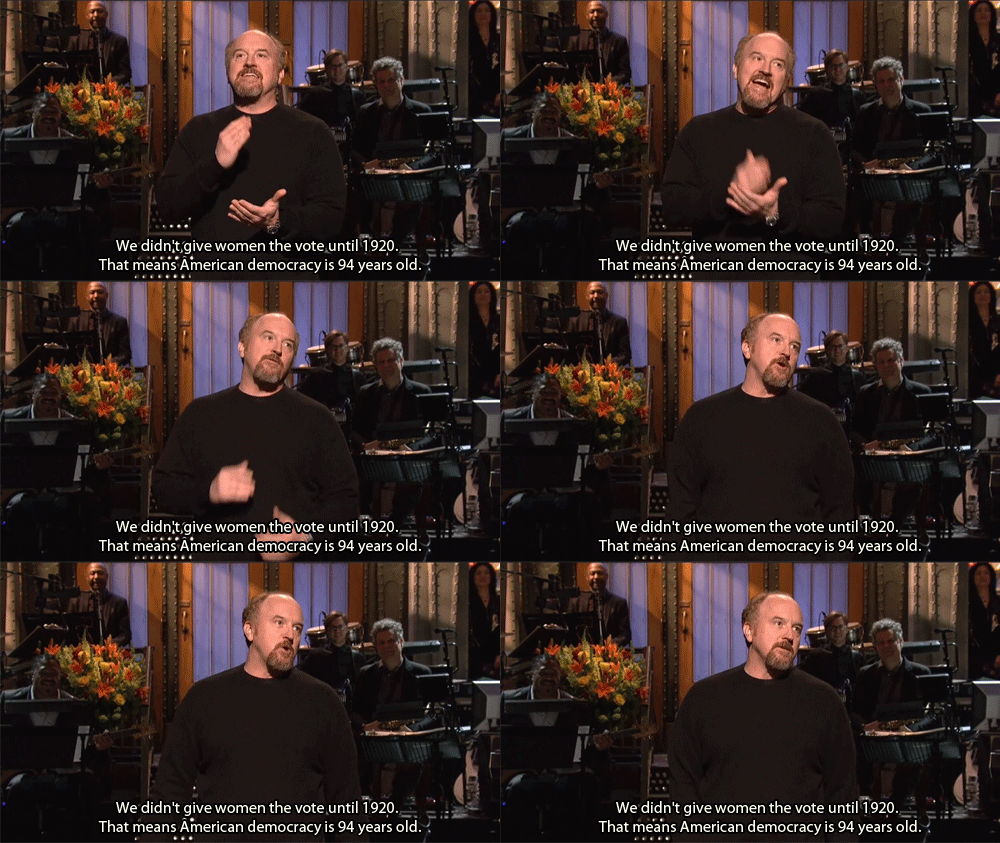
Several months ago, I commented on Steve Sailer's blog (regarding Patton Oswalt's reference to him), "Louis CK? There's no hope for that guy. He's friendzoned the dark side."

For a time, I thought he was the best comic working but he's assumed the role of Righteous Speaker of Truth, and revealed himself to be just another idiot savant able to make the audience laugh despite having a head full of received wisdom. The above is applause-bait, a "clever" turn of phrase that relies on a shallow knowledge of history and a loose understanding of democracy.

But the sentiment itself is indicative of more. Earlier this week, 28 Sherman asked the question, "Who Pushed Women's Suffrage 100 Years Ago?"


Son of Brock Landers puts this cartoon circa 1912, four years before the issue made the Democratic platform. The answer to the question, "Who pushed it?," is, of course, the media.

Which brings me to Bruce Charlton's theory of the mass media being the very center of the left. And to my thoughts about the left being the inextricable degenerative force within democracy. 

The enfranchised is a smaller set within the total population. The mass media's audience is the total population. The trend, unless directly opposed (similar to Derbyshire's Second Law of Conquest/John Sullivan's First Law), is for the set of enfranchised individuals to approach the number of the total population.


We could ponder why democracy pushes toward greater and greater enfranchisement. We could ask why the mass media is eternally shuffling the populace into newer and angrier mobs. John C. Wright has diagnosed the paradoxes in his Unified Theory of Madness.

But maybe it's better to view democracy and mass media as metaphysical objects. Why does democratic enfranchisement expand? Why do wolves howl at the moon? That's what it does, whether you want it to or not. 

The Tumblr comments are very much as one would expect, more righteous than even Righteous Louie himself. The Voting Rights Act didn't pass until 1965. Native Americans couldn't vote until 1924.

We could engage such thinkers with arguments, pointing out that the original democratic proponents were open about their contempt for mob rule. We could argue that there isn't a compelling reason for those that don't contribute to the state to have a voice in it, especially if their only contact with it is cashing the government's checks and being restrained by the police.

(The progression, by the way, goes from, "Why should those powdered aristocrats tell me, an educated and affluent man, what taxes to pay when I can't even argue?" to, "Why should those non-inebriated job-holders tell me, an ostensible human being, not to perform any act that pops into my head?" Is John Adams' indignation all that different from your average drunken "rebel?")

There's no point in convincing them, though. They believe in democracy. Instead, we should shrug when they rage at the government for corruption or at the press for being divisive. "That's democracy," we should say. "When you let a monkey in your house, you can't get mad at it for shitting on the floor."

Wednesday, April 2, 2014

A Light in the Gloom

Kristor at The Orthosphere caught some attention with the post Onward, Christian Bloggers:
So, we need not feel discouraged that the orthosphere, or Neoreaction more generally, have not yet exploded in popularity...We must rather look ahead to the next iteration of the High Middle Ages. Our proper purpose is like that of Lindisfarne, and Alcuin: to shine in the gathering gloom a glimmer of the eternal light of Truth, so that in the wreckage of the collapse that seems daily more inevitable, we and the readers who discover us in the next few years will be philosophically, morally and spiritually prepared to propose by our acts a social order founded on reality – which, in a collapse, is anyway already asserting itself with a vengeance.
This is very much what I've been getting at when writing about neoreaction. While it's an exciting project to create a government from scratch, the public isn't agitating for a new system. Not because our current system is so great but because they've never considered that it isn't so great. "Democracy is the worst form of government except all the others that have been tried."

Here's another quote:  “Men, it has been well said, think in herds; it will be seen that they go mad in herds, while they only recover their senses slowly, one by one,” Charles Mackay said.

The non-establishment right is full of individuals who have recovered their senses alone. The myth of progress is seductive; it provides moral superiority with no heavy lifting. And most who have been seduced will only repent when they have no choice but to see that it was all a lie.

Wednesday, March 26, 2014

When No One Can Be Believed

Outside In quotes Jim:
The climategate files not only give us reason to disbelieve “Climate Science”, but discredit all peer reviewed science. Peer review means you don’t get the actual evidence, but rather the consensus about what the evidence should show if it was not so wickedly prone to evil heresy. Peer review means that a consensus is quietly established behind closed doors, and then the evidence is corrected to agree with the consensus. This maximizes the authority and prestige of official science, at the expense of disconnecting it from reality.
This principle has been on my mind lately. At my day job, our industry has just gone through another federally-mandated materials change. Without getting too specific, one of the materials has had a tiny amount of a toxic substance. The "safe" level of this substance was set most recently about twenty years ago. This year, the manufacturers were forced to include an even smaller amount of that substance.

I won't go into the hours of conversation I've heard about how the old level is no more dangerous than the new level. What has happened is that, due to the law's specificity, parts with the old level are still available for sale. They can't be used in all applications, but they are still out there.

Naturally, the change in materials required a lot of research and development, followed by retooling. The new parts are more expensive than the old. I'm sure that there are a large number of end-users who continue to use the old products in now-prohibited applications--it's just cheaper.

Here's the thing:  Now we have a product that the government has labeled "Unsafe." A year ago, it was "Safe." Scientifically, there's no real difference in the dangers between the two levels. Those in the know have no problem using the products labeled "Unsafe."

The sign saying, in effect, "Danger! Danger!" is now meaningless. The line between "safe" and "dangerous" is so far within the safety zone that no one is paying attention to it. Which means that the real danger is unmarked. If people have no hesitation using "unsafe" products that are actually safe, how will they know when they come across something that really is dangerous?

Jim's quote points to this from a different direction. If scientific consensus is so easily manipulated, then what scientific information can we believe?

I've been trying to project what this phenomenon becomes. I think that America's most prominent example is vaccine truthism.

This brand of skepticism comes from progressives. Hippie values say that the medical industry's goal is to pump us full of chemicals, driven by profit and unconcerned with the long-term consequences. Some parents still believe there's a link between vaccinations and autism. Others are concerned with the particular chemicals used to preserve the vaccines.

If a significant portion of the population rejects vaccination, then the public becomes a breeding ground for vaccine-proof diseases. The disease always has a safe zone from which it can mutate and re-attack the general public--and re-attack as many times as it takes to be successful. The danger is increased for all.

But we should be distrustful of the medical industry and the government that regulates it. The days of WASP paternalism are over; persuasion is no longer accomplished by cautious logic but by hysteria and/or money.

This is end-stage democracy--no authority can be trusted. Not just because they are dishonest but also because they don't know what they're talking about. The warning signs are meaningless--the whole terrain is wilderness.

Friday, March 21, 2014

Prudence is Our Greatest Virtue

Adam Gurri at The Umlaut tells us Prudence is a Virtue:
If you assume a notion of justice, or an extremely other-directed moral philosophy, in which the entire purpose of our lives is to provide for other people, prudence is still a crucial virtue. If you cannot provide for yourself, you cannot hope to provide for others. Au contraire; the selfless and imprudent saint becomes nothing more than a sinking ship, who is more likely to pull those he wishes to help to the bottom of the ocean with him, rather than improving their lot. If you cannot provide for yourself, how can you hope to provide for others?
In my foot-dragging path back to Catholicism, contemplating prudence was a major step. To hear progressive Christians and holier-than-thou leftists tell it, there is no martyrdom too stupid to avoid. Better to open one's borders to foreign cultures and endanger one's neighbors than to be intolerant. Better to allow all manner of sexual deviance at one's doorstep than to be judgmental. It's no virtue to allow one's children to be slaughtered because one is a pacifist. A pacifist is not what the children need.

As Gurri points out, prudence is the balance by which all moral judgments must be measured.

When thinking about human society, my starting point is the isolated village of the pre-modern age. The population and resources are small. Travel to the nearest city takes days. The monarch's army is nowhere close.

Assume you are the patriarch of that village and a stranger has come into town and murdered a resident. He is captured and brought to you for justice. He swears that, given a chance, he will kill again, and will do so as long as he is able.

What is the appropriate action? There is no prison in the village--the crimes committed there don't require major penalties. It's impossible to confine the man for the rest of his life--the necessary resources aren't there nor is there a way to keep him permanently locked away. The prudent action is to execute him.

But isn't taking a life a sin? Yes, but the patriarch has an obligation to his village, who look to him for protection and guidance. Is it better to let the man loose to wreak violence on them? Say he is escorted out of the village--is it moral to sentence a stranger to certain death?

No. The patriarch's obligations to the dependent and the innocent outweigh his obligations to the murderer as a fellow human. So he orders an execution and prays for forgiveness.

The progressive evolution described by Moldbug as an outgrowth of Quakerism and Unitarianism is really just Christianity stripped of prudence. There is no hierarchy of virtues or vices--every moral failing or achievement can be thrown into an enemy's face, like when Alec Baldwin discovered that his years of championing liberal poverty and environmental policies meant nothing because he was thought homophobic.

Prudence tells us how to make the best of the world as it is. That's why it's the highest of virtues man can achieve without God's intervention.

Wednesday, March 12, 2014

Thinking about Charlton's Theory of Mass Media

One would think that as a former journalism student, I'd have an easier time understanding what Bruce Charlton means here:
But at a more proximate level; the way the Left works can be seen by the one-and-only example of an institution which has actually grown in power, wealth, effectiveness and efficiency over the past three decades: the modern Mass Media.  
I have argued that the modern Mass Media is in fact the centre of Leftism and the central power in modern society - the Mass Media is the primary social system; and dominates all other social systems.  
And the modern Mass Media has zero social function - it is overwhelmingly destructive in its net effect - it destroys cohesion, it destroys all other social systems, it encourages a psychological state and social mechanisms which are intrinsically and open-endedly anti-functional. 
I certainly agree with that last paragraph but I'm having trouble marrying the whole of the Left to the whole of mass media. Charlton doesn't tag his posts, so I'm just going to have to stay tuned.

I do think that it has something to do with the idea I've been trying to articulate that leftism is the degenerative force of democracy and is intrinsic to democracy. Democracy, in theory and practice, is about mobilizing and amassing the desires of individuals. This, in itself, is a weakness that encourages selfish, anti-social political action. Democracy, in its demand for constant activity, will push until it has universal suffrage.

The left is the democratic force that stokes political individualism--that is, selfishness. It accomplishes this by framing issues as win-lose scenarios and pits groups of individuals against one another. As universal suffrage is achieved, it's necessary to create further divisions among society.

What we've seen in the past half-century is a relentless shaving of the majority bloc into tiny, single-issue blocs. These smaller blocs are amassed into a mob agitating against the majority. The advocate for slavery reparations has little in common with the feminist--except for their enemy, the average American.

I don't have it all worked out but the mass media is an integral part of the equation. The hottest issues--gay marriage, trans rights--are about increasingly small slivers of the population, but the introduction of each new issue equals another handful of voices shouting in the mob. The momentum grows stronger, even as there is less and less resistance.

I'll be thinking about it. And don't think that my distributist eye didn't catch the "mass" in "mass media."